
Profile Perfect
Lion Studios PlusPuzzle
4.4959.00 Reviews
- Version
- 1.2.0
- Installs
- 1.00M
- Age Rating
- Teen
Screenshots
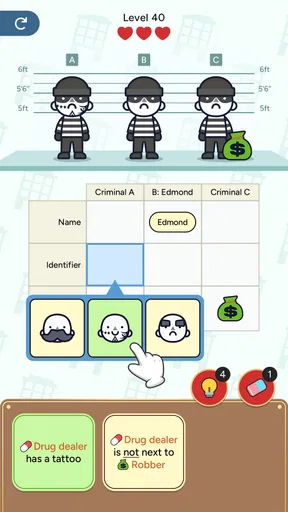
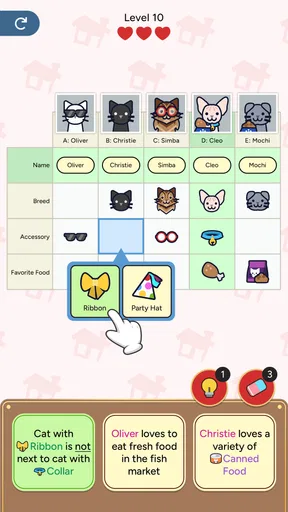
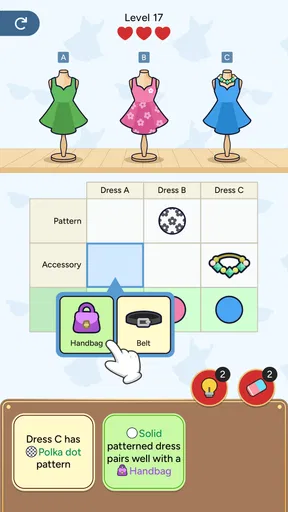

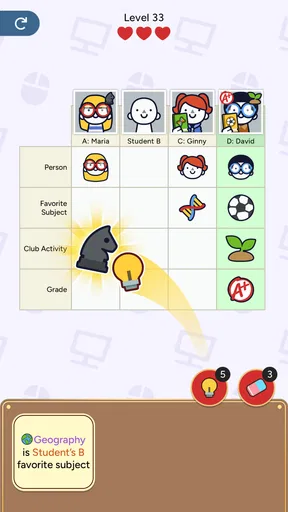
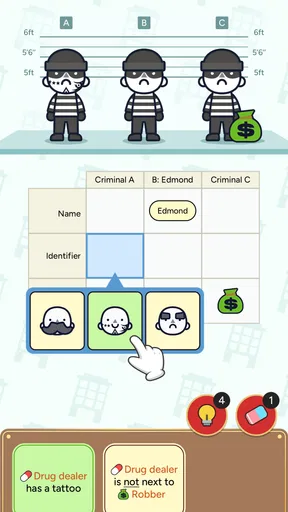
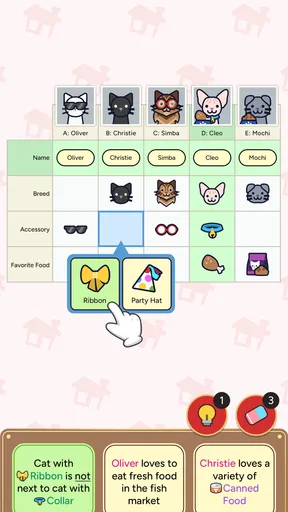
Our Review of Profile Perfect
 Analysis by Appyee
I spent time with Profile Perfect as a logic puzzle game, paying particular attention to how comfortably it works in different situations and for different players. Its central idea is simple: you examine clues, connect people or details, and complete logic grids until the hidden arrangement becomes clear. That makes it easy to understand, but the challenge comes from reading carefully rather than reacting quickly.
That distinction matters. This is not a reflex game, a colorful matching game, or a casual title you can solve by tapping randomly. It asks you to hold several facts in mind, test possibilities, and remove contradictions. I found that approach satisfying when I wanted a quiet mental break, although it also means the game is less forgiving if small text, dense information, or prolonged concentration is difficult for you.
How Profile Perfect feels to read, control, and use
I approach this section through the practical details that shape a puzzle session: how easily I can follow the clues, keep my place, and make deliberate selections. The key is to treat each grid as a small workspace rather than scan everything at once; that habit can make the reasoning feel calmer and help me spot where the actual challenge lies.
A clear puzzle idea with a reading-heavy interface
The strongest part of the experience is the relationship between the clues and the grid. Once I understood that each clue was meant to narrow down a relationship rather than provide an immediate answer, the puzzles became much easier to approach. I could work methodically instead of guessing, which is exactly what I want from a logic puzzle game.
The game’s presentation is built around information. That can be a strength for players who like orderly layouts and written reasoning, because the task feels focused rather than overloaded with unrelated action. It is also useful for someone who prefers to solve at their own pace. You can pause mentally, reread a clue, and return to the grid without needing fast timing.
At the same time, a grid is not automatically easy to read. Rows, columns, clue text, and marks can compete for attention, especially on a smaller phone. I found that the best approach was to read one clue at a time and keep my attention on the specific pair of categories it affected. Trying to scan the whole board at once made the puzzle feel more confusing than it really was.
For readers who are sensitive to visual clutter, this is an important trade-off. The game’s core structure is more restrained than an action-heavy mobile title, but the reasoning surface can still become busy. A player who benefits from large type, strong separation, or generous spacing may need to test the game personally before committing to long sessions.
Navigation is easiest when you treat each puzzle as a workspace
I found the navigation most comfortable when I resisted rushing between clues and the grid. My practical routine was to read the clue, identify the two relevant groups, make the corresponding deduction, and then look for the next clue that could confirm or challenge it. This reduced unnecessary movement and made the board feel more manageable.
That workflow also helps players who find frequent visual switching tiring. Instead of jumping around the entire screen, you can keep a small mental target: one clue, one relationship, one decision. It is a modest habit, but it changes the experience from a broad scanning exercise into a series of smaller tasks.
There is a second useful habit: do not treat every empty space as a problem that must be solved immediately. Logic grids often become clearer after a few certain relationships are established. I found it more comfortable to mark only conclusions I trusted and leave uncertain possibilities alone until another clue resolved them. This avoids filling the board with speculative choices that later have to be untangled.
That method is especially helpful for people who experience cognitive fatigue. It lowers the number of decisions being held at once and makes mistakes easier to trace. The game rewards patience, so there is little benefit in turning every puzzle into a speed test.
Motor demands are modest, but precision still matters
Profile Perfect does not depend on rapid swipes, repeated tapping, or precise timing in the way many mobile games do. That is a meaningful advantage for players who prefer slower interaction or who find fast controls uncomfortable. The basic activity is selecting and interpreting information, not reacting before a timer expires.
However, a logic grid still requires accurate selection. If the cells are close together, a player with reduced fine-motor control may find it easier to slow down and tap deliberately rather than working quickly. A stylus or a larger-screen device could make this kind of interaction more comfortable for some people, although the game itself should be judged on the device where you plan to play.
One practical strategy is to use short sessions instead of trying to finish a complete set of deductions in one sitting. I would solve a few relationships, stop when my attention dipped, and return later with the current logic in mind. This is not only easier on the hands; it also prevents tired concentration from turning a simple contradiction into a frustrating mistake.
Players who need one-handed operation may have a different experience depending on the phone’s size and how the grid is arranged on screen. I would not choose this game specifically for effortless one-thumb play. Its design asks you to look, compare, and select carefully, so two-handed use or a stable resting position may feel more natural.
Visual and sensory comfort depends on the person
The game is a better fit for players who enjoy quiet, text-led problem solving than for anyone seeking constant animation or dramatic sensory feedback. That can make it a pleasant choice in a calm room, during a break, or while unwinding before bed. The mental activity remains present without requiring the intensity of an arcade game.
Still, “quiet” does not mean universally comfortable. Reading clues and comparing grid entries can place a steady demand on the eyes. If you are sensitive to small text or have difficulty distinguishing nearby marks, the central puzzle format may be more significant than the game’s overall visual style. I would approach it as a reading exercise with game elements, not as a purely visual relaxation app.
Contrast and symbol clarity are particularly important in a grid. A player who relies on color differences alone may find some deductions harder if marks are subtle or similar. My advice is to focus on the meaning of each relationship and use a written reasoning process rather than depending only on visual patterns. That also makes the game more approachable for people who do not naturally process dense diagrams quickly.
Players with attention differences may appreciate the narrow goal of each puzzle, but the same structure can become demanding if switching between clue text and grid entries is tiring. I found that externalizing the reasoning helped: I mentally summarized a clue in plain language before applying it. For example, instead of repeatedly rereading a sentence, I reduced it to a simple relationship such as “this person cannot belong with that item.” That small translation made the information easier to retain.
Where it fits into everyday situations
A realistic use case is a short waiting period when you want something more engaging than scrolling but less demanding than a full game session. I could imagine opening it during a quiet commute, in a waiting room, or during a lunch break. The important condition is that the surroundings allow concentration. A noisy environment, frequent interruptions, or poor visibility can make the clue-reading process much less enjoyable.
It can also work as a screen-time alternative for someone who wants a deliberate activity. Instead of consuming an endless feed, you have a defined problem and a clear sense of progress. That does not make it automatically better for every person, but it gives the session a natural stopping point: finish a deduction, pause, and return later.
For shared use, the game could be an interesting conversation starter between friends or family members who enjoy reasoning together. One person can read a clue while another suggests what it rules out. However, it is not ideal if one player needs a very different reading pace from the other, because the puzzle depends on keeping track of several details. A cooperative board game may be better for groups that want explicit turn-taking and shared physical space.
It is also worth considering the age guidance. The game is marked Teen, so I would not automatically present it as a children’s puzzle without checking whether it suits the younger player in your household. The reasoning format may appeal to older children and adults, but the stated age category should guide that decision.
How it compares with familiar puzzle alternatives
Compared with a word search, Profile Perfect asks for more deduction and less visual hunting. A word search gives you a target hidden among letters; here, the target emerges from combining clues. That makes this game more rewarding for players who enjoy building a chain of evidence, but less suitable for someone who wants a quick, low-memory activity.
Compared with Sudoku, the experience is more language-dependent. Sudoku mainly uses numerical patterns and spatial elimination, while this game asks you to interpret written relationships and map them onto categories. If numbers and symmetrical grids are easier for you than sentences, Sudoku may remain the more comfortable choice. If you like solving small mysteries through statements and exclusions, this title has the stronger appeal.
Traditional paper logic-grid puzzles still offer one advantage: you can enlarge the page, use a pencil, and arrange it exactly as you like. A phone game is more convenient because it is always close at hand and keeps the puzzle in a compact format, but it cannot replace the flexibility of a large sheet for every player. Someone with visual or motor needs may prefer paper, a tablet, or a dedicated puzzle book simply because the physical workspace can be customized.
On the other hand, a purely casual matching game is easier to play while distracted. Profile Perfect demands more attention, but that demand is also its purpose. I would choose it when I want my brain involved, not when I need something to fill a few seconds with minimal effort.
What the free model means in practice
The game is free to download, which makes it easy to try without paying at the start. It includes in-app purchases ranging from under a dollar to amounts approaching a hundred dollars per item. That broad range is something I would keep in mind before handing the phone to a younger player or allowing purchases without supervision.
For me, the right way to evaluate the free version is to ask whether the available puzzles and progression already suit my habits. A free download is useful here because the appeal depends heavily on how comfortable you find the reading and grid interaction. If the format does not fit your eyes, attention, or preferred pace, paying for extras will not solve that basic mismatch.
Players who dislike purchase prompts should be especially attentive to how the game presents optional spending during normal play. I would make purchase controls clear on a shared device and avoid assuming that “free” means the entire experience is cost-free. The price structure does not reduce the value of trying it, but it does make spending awareness part of the decision.
Technical context and long-term suitability
The current version is 1.2.0, and the game supports Android 7.0 and later. That gives it a relatively broad device range, which is helpful if you are using an older Android phone rather than a recent flagship. Still, operating-system compatibility does not guarantee identical comfort across screens. A device that technically runs the game may not be the one on which the grid feels easiest to inspect.
Lion Studios Plus is the developer behind the title. The game has passed one million installs and holds a 4.4 average from around seventeen thousand ratings, with 959 written reviews. Those figures suggest that the concept has reached a substantial audience, but they should not replace your own judgment about readability and control comfort. Puzzle games can be especially personal: a layout that feels wonderfully clear to one person may feel cramped to another.
The release date is August 15, 2025, so I would treat the current version as the relevant snapshot when deciding whether to install it. If you are choosing a game for a long-term routine, it is sensible to revisit its behavior after updates rather than assuming every future version will feel exactly the same.
Who should try it, and who should look elsewhere
I would recommend Profile Perfect to someone who likes written clues, elimination, and the satisfaction of proving an answer rather than guessing it. It is particularly appealing if you want a puzzle that can occupy a quiet break and still feel mentally substantial. Players who enjoy making notes, checking contradictions, and solving in stages will probably get the most from it.
I would be more cautious if you want large, instantly readable controls, a highly adjustable interface, or a game that remains comfortable while you are distracted. The central grid can be demanding for anyone who struggles with dense visual information, sustained reading, or precise tapping. In those cases, a paper puzzle with enlarged formatting, a tablet-based alternative, or a simpler number puzzle may be a better fit.
It is also not my first choice for a noisy commute or a social setting where I will be interrupted every few seconds. The game benefits from continuity: clues build on one another, and losing track of a deduction can force unnecessary backtracking. A faster matching game would serve that situation better.
My inclusive verdict after using it
Profile Perfect succeeds because it gives logic puzzles a compact, approachable home on a phone without turning them into a reflex challenge. I liked the feeling of narrowing possibilities until the answer became unavoidable. The game respects careful thinking, and its slower pace can be welcoming for players who do not enjoy speed-based mobile design.
Its accessibility in everyday use is more mixed. The lack of rapid action helps with motor pacing, but the reading-heavy grid still asks for visual focus, accurate selection, and sustained attention. That means the most important question is not whether you like puzzles in general; it is whether this particular way of presenting clues works comfortably on your screen.
My best advice is to test it during the kind of session in which you expect to use it. Try a short puzzle in good lighting, hold the phone in the position you normally use, and notice whether you can follow the clue-to-grid movement without strain. If that feels natural, the free entry point makes the game easy to explore. If it feels cramped or mentally tiring, no amount of enthusiasm for logic puzzles will make it the right tool.
Overall, I see it as a thoughtful choice for patient puzzle fans and a less convincing one for players who need highly flexible presentation or effortless casual play. The real strength is its evidence-based solving; the real limitation is that the same dense reasoning space can create barriers for different eyes, hands, and attention styles. With realistic expectations, it is a worthwhile free puzzle to try, especially when you want a focused challenge rather than another disposable tap-and-match game.
Verdict
Strengths of Profile Perfect
- Simple tools make profile photos easy to crop, resize, and improve.
- Useful templates help create a consistent look across social platforms.
- Quick editing workflow suits users who want results without advanced skills.
- Previewing changes before saving helps avoid poorly framed profile images.
- Export options make it convenient to prepare photos for different networks.
Limitations of Profile Perfect
- Some useful editing features may be restricted to premium access.
- Results depend heavily on the quality and lighting of the original photo.
- Templates can feel repetitive if you want a highly personalized design.
- Automatic enhancements may look unnatural on some faces or images.
- Saved images may require extra storage space, especially at higher quality.
Other Releases by Lion Studios Plus
View All
Match 3D -Matching Puzzle Game
Puzzle4.5

Hexa Sort
Puzzle4.5

Wordle!
Word4.5

Point Out: Color Escape Puzzle
Puzzle4.6
Similar Picks in This Category
View All
Block Blast!
HungryStudio4.8

Braindom: Brain Games Test
Lahana Game Studio4.6

AMAZE!
CrazyLabs LTD4.6

Sudoku - Classic Sudoku Puzzle
Oakever Games4.7

Art Puzzle - Puzzle Games
Easybrain4.8

Amaze GO!
Oakever Games4.9
Frequently Asked Questions
What is Profile Perfect and what can I use it for?
Profile Perfect is designed to help users create a more polished and attractive online profile. Depending on the available tools in your version, it may offer profile photo improvements, editing features, templates, or suggestions for presenting yourself more effectively. It can be useful for social networks, dating apps, professional platforms, and other services where your profile image and presentation matter.
Is Profile Perfect free to download and use?
Profile Perfect may be available as a free download, but some editing tools, templates, effects, or advanced profile features could require in-app purchases or a subscription. Before using premium options, check the pricing details shown in the app store and inside the application. Also review whether a trial automatically changes into a paid subscription and learn how cancellation works on your device.
Does Profile Perfect protect my photos and personal information?
Because Profile Perfect may require access to photos, camera functions, or other device permissions, it is important to review its privacy policy before uploading personal images. Check whether edits are processed on your device or sent to online servers, how long files are retained, and whether information is shared with third parties. Grant only the permissions that are necessary for the features you intend to use.
Can I use Profile Perfect without professional editing experience?
Yes, Profile Perfect is generally intended for everyday users rather than professional designers. Its guided tools, presets, automatic adjustments, and simple editing controls can make it easier to improve a profile without learning complicated software. However, the final result still depends on the original photo, lighting, and the options selected, so reviewing the preview carefully before saving or publishing is recommended.
Will Profile Perfect work on my Android or iPhone?
Compatibility depends on the specific Android or iOS version, device model, available storage, and the requirements listed on the official app store page. Older phones may support the basic application but perform more slowly when processing high-resolution images or advanced effects. Before downloading, check the latest operating-system requirements, app size, update history, and whether all advertised features are available on your device.
Play our best games!


